
Following my recent article on the UK Budget, I've been reviewing the latest property market research and speaking with developers, industry professionals and international investors about the outlook for 2027.
There is understandably some uncertainty surrounding the UK property market. Higher borrowing costs, increased landlord taxation, regulatory reform and weaker capital growth forecasts are all influencing investment decisions. However, the UK is not one uniform property market.
Having worked in international property investment for over 20 years, I've experienced several market cycles. One of the most valuable lessons has been that the quality of an investment is often determined by the decisions made at the point of acquisition.
In this edition, I explore the latest market intelligence, the challenges facing landlords and why Northern England remains an area of particular interest.
1. UK house price forecasts have been downgraded
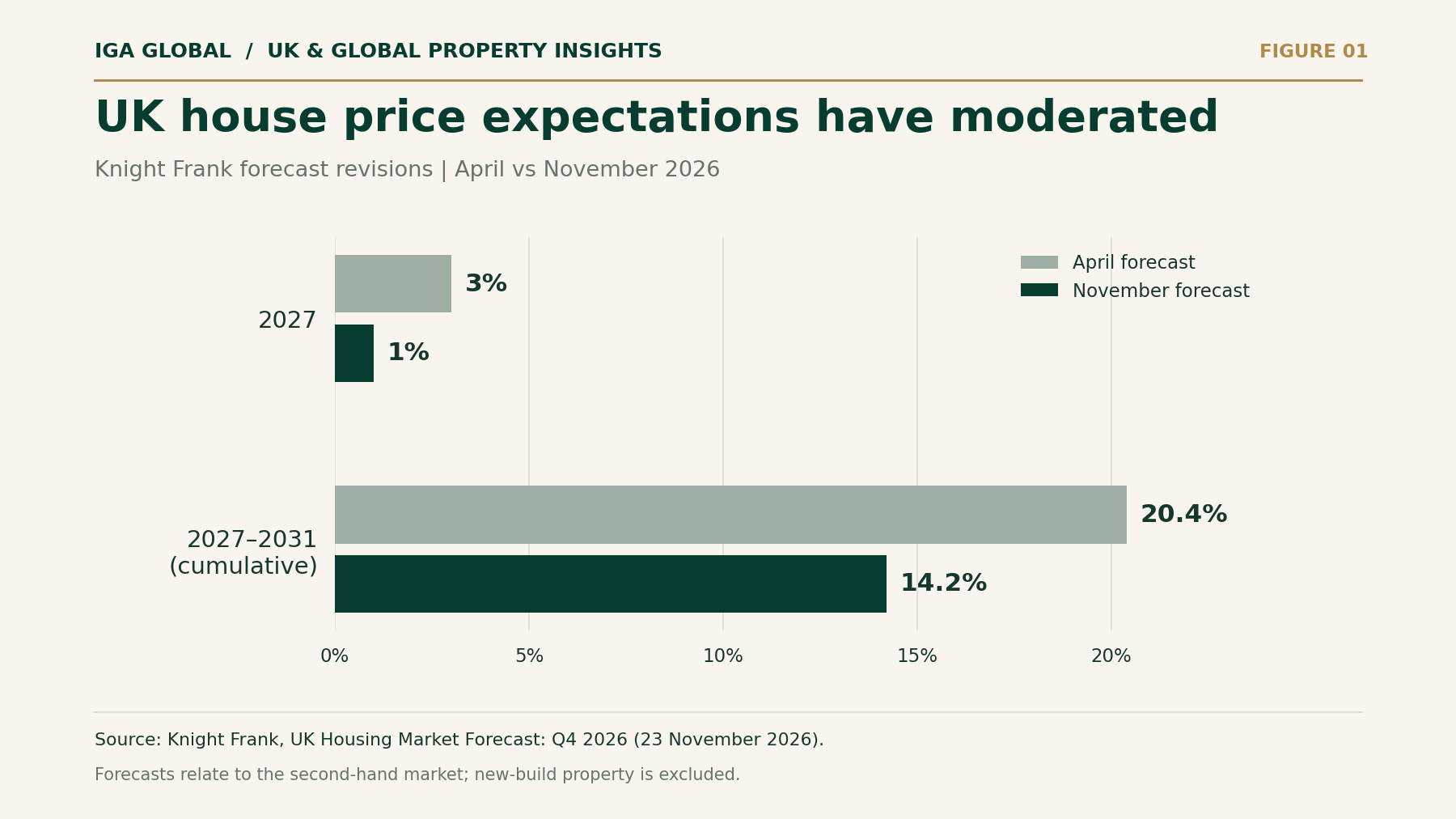
Knight Frank published its revised UK housing market outlook on 23 November, reflecting a more challenging economic environment. Its latest forecasts anticipate 1% UK house price growth in 2027, revised down from 3%, and 14.2% cumulative growth over the five years to 2031, revised down from 20.4%.
Meanwhile, Savills forecasts a national decline of 1.5% in 2027, followed by a gradual recovery from 2028. The Bank of England's November decision to increase the base rate to 4% also highlights the ongoing challenges surrounding borrowing costs and affordability.
These forecasts are a timely reminder that property markets do not move in a straight line. In my view, investors should be focusing less on trying to predict the bottom of the market and more on whether an individual investment makes financial sense under conservative assumptions. Purchase price, rental demand, financing costs and the ability to hold an asset through different market conditions remain fundamental.
2. Could rental growth outperform capital appreciation?
One of the more interesting developments is the divergence between house price and rental growth expectations. The latest figures from the Office for National Statistics show:
- Average UK monthly private rent reached £1,411 in October 2026, representing annual growth of 3.8%.
- North West England recorded annual rental growth of 5.6%, the highest among English regions.
- UK house prices increased by 1.2% in the year to September 2026.
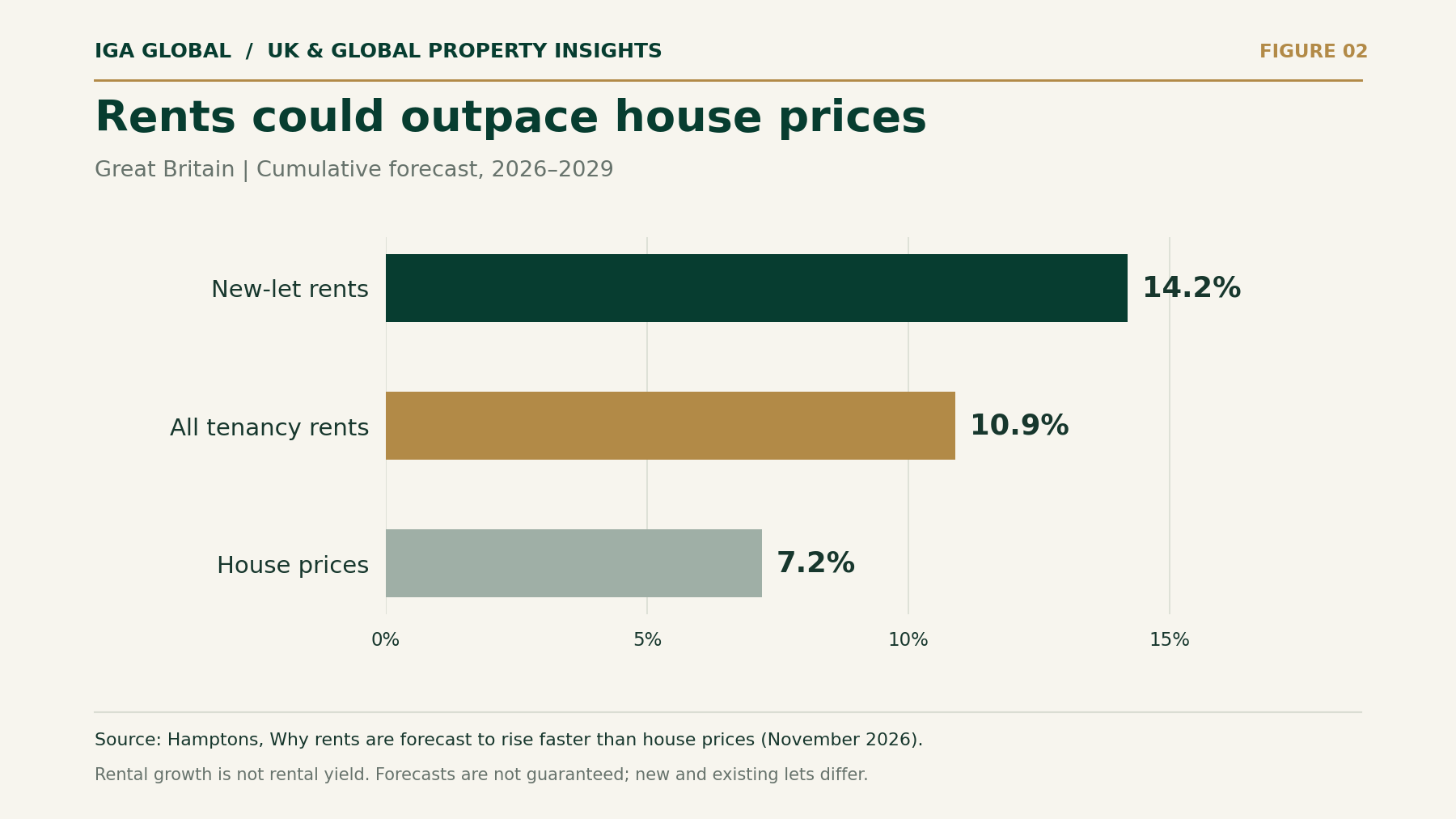
Meanwhile, Hamptons forecasts cumulative rental growth of 14.2% for newly agreed tenancies over its 2026–2029 forecast period, compared with house price growth of 7.2% across Great Britain.
A constrained supply of rental accommodation, alongside affordability challenges for prospective homeowners, continues to influence rental market conditions. However, rising rents do not necessarily mean rising landlord profitability. Taxation, mortgage costs, service charges, maintenance and regulatory compliance must all be factored into an investment assessment. For international investors in particular, the distinction between an advertised gross yield and sustainable net rental income has never been more important.
3. Is this the beginning of the end for leasehold?
On 19 November, the government introduced its Commonhold and Leasehold Reform Bill to Parliament, marking another significant step towards modernising residential property ownership in England and Wales.
The proposed measures include a £250 annual ground rent cap for qualifying existing leases, an easier process for existing leaseholders to transition to commonhold, greater protection against unexpected major repair bills, and commonhold becoming the standard ownership structure for most new flats following a transition period.
Under commonhold, apartment owners collectively control their building without the traditional freeholder and leaseholder relationship. Importantly, these proposals have not all become law, and implementation is expected to take place in phases. There are also wider changes affecting landlords through the Renters' Rights Act, including the introduction of a national landlord registration system in England.
For overseas investors, understanding the legal ownership structure, ongoing service charges and regulatory obligations should form an essential part of the due diligence process.
4. Why Northern England remains particularly interesting
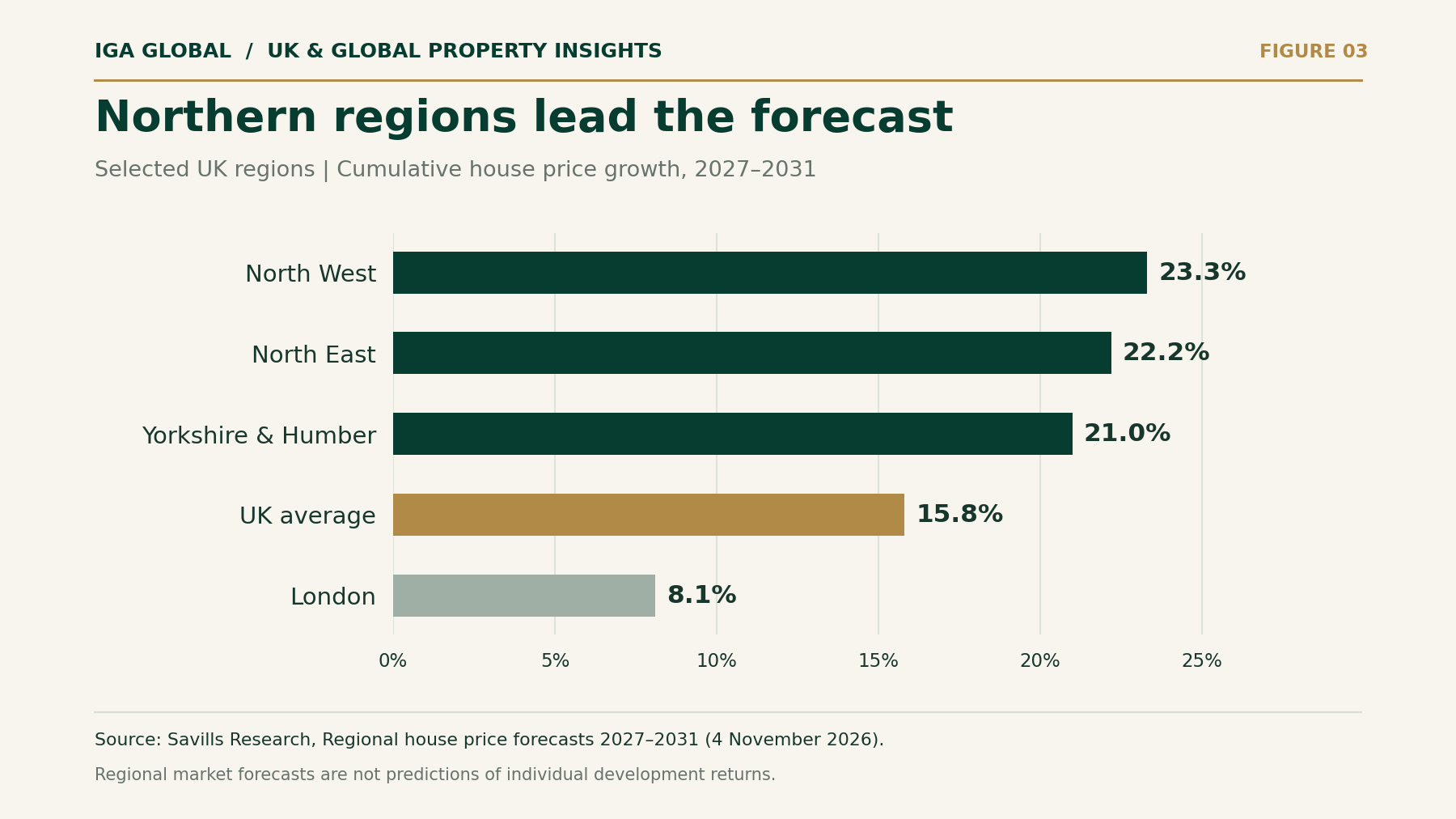
Despite the more cautious national outlook, regional forecasts tell a rather different story. Savills' latest five-year house price projections identify Northern England among the markets with the strongest potential growth.
Projected cumulative house price growth, 2027–2031: North West 23.3%; North East 22.2%; Yorkshire and the Humber 21%; UK average 15.8%; London 8.1%.
Relative affordability, economic development, employment opportunities and regeneration are important considerations when assessing these markets. Three cities that remain particularly relevant to our research at IGA Global are:
Manchester: A diversified regional economy, established employment centres, universities and ongoing urban regeneration.
Liverpool: A relatively accessible property market supported by regeneration, education, healthcare and a growing service-based economy.
Leeds: An established financial, professional services and technology hub with a substantial regional economy.
Of course, investing in a strong city does not automatically mean investing in a strong property. Local supply, competing developments, building quality, achievable rents and entry pricing all require careful assessment. Regional forecasts should never be confused with guaranteed returns on individual developments.
5. Where am I seeing opportunities?
Over recent weeks, we have been reviewing a number of opportunities across Greater Manchester, including completed apartments where developers are motivated to sell their remaining stock. We are also introducing Peelers Yard, a new residential development in Ancoats, Manchester, to our international investor network.
What interests me is not simply whether a property is being offered at a discount, but whether the acquisition price represents genuine value relative to comparable properties and realistic rental expectations.
At IGA Global, our current focus includes completed properties offering credible entry value, carefully selected developments in established regeneration locations, properties supported by realistic rental fundamentals, and investment opportunities aligned with long-term ownership objectives. Not every opportunity will be suitable for every investor, and thorough due diligence remains essential.
Free live webinar
The Rise of the North
UK Property Investment Outlook 2027
12:00 UK · 14:00 South Africa
To explore these themes in greater detail, I will be hosting an online investor briefing alongside Henry Shaw MRICS, Sales Director at BuyAssociation.
On the agenda
- The outlook for Manchester, Liverpool and Leeds
- Regional growth forecasts and rental market fundamentals
- Regeneration and emerging investment locations
- Key risks and considerations for international investors
- Selected new and off-market property opportunities
Final thoughts
The UK property market is becoming increasingly selective. I do not believe investors should ignore the challenges facing the market, nor should they allow negative headlines alone to determine their investment decisions. There will always be opportunities and risks within every market cycle. The key is knowing how to distinguish between the two.
If you are considering UK property investment in 2027 or reviewing an existing portfolio, I would welcome a conversation.
Thank you for reading, and I look forward to sharing further insights in the next edition.
Dale Anderson | Founder & Managing Director, IGA Global
Founder-led international property investment advisory | Over 20 years of market experience
Research and references (carried forward from editorial draft; reconfirm before publishing)
- Knight Frank: https://www.knightfrank.co.uk/research/article/2026/11/uk-housing-market-forecast-q4-2026
- Savills: https://www.savills.co.uk/research_articles/229130/396183-0
- Hamptons: https://www.hamptons.co.uk/articles/why-rents-are-forecast-to-rise-faster-than-house-prices
- ONS: https://www.ons.gov.uk/economy/inflationandpriceindices/bulletins/privaterentandhousepricesuk/november2026
- Bank of England: https://www.bankofengland.co.uk/monetary-policy-summary-and-minutes/2026/november-2026
- UK Government: https://www.gov.uk/government/collections/commonhold-and-leasehold-reform-bill
- Renters' Rights Act: https://www.gov.uk/government/publications/renters-rights-act-2025-implementation-roadmap
IGA Global markets selected property opportunities and may receive remuneration from property providers. This article is for general information and does not constitute personalised financial, legal or tax advice. Property values and rental income can fall as well as rise. Forecasts are not guaranteed. Investors should undertake independent due diligence and obtain appropriate professional advice.